Be yourself; Everyone else is already taken.
— Oscar Wilde.
This is the first post on my new blog. I’m just getting this new blog going, so stay tuned for more. Subscribe below to get notified when I post new updates.
Be yourself; Everyone else is already taken.
— Oscar Wilde.
This is the first post on my new blog. I’m just getting this new blog going, so stay tuned for more. Subscribe below to get notified when I post new updates.

As a preparation for writing this final blog post, I went through my previous four posts to remind myself of the work that has been done and my own, personal reflections along the way. While going through the old posts, I was a bit surprised to realize that so much had happened in such a relatively short period of time. 12 weeks. My conclusion is that I have learned a lot. In fact, I have learned more than I thought I had (if that makes any sense). We all know that reflection is a powerful tool in teaching, but we rarely find enough time to reflect in any depth (or at any length) in our daily work. I know I try to reflect regularly on my work, but to be quite honest (and especially this crazy spring semester of 2020), working hard as a researcher and teacher makes it challenging to find enough time for reflection. But it is essential, and reflection has paid off as a useful tool in the design of this course. I doubt a longer paper at the end would have increased my learning from participating in the course. Thus, a very important lesson learned through my engagement in ONL201: Make sure I plan for time for reflection in my daily work. Reflection is essential to consolidate learning.
How will my learning from participating in ONL201 influence my practice? Well, the very first component from ONL201 that I started using in my own teaching practice was to ask students to take on roles as facilitators in my various online courses (i.e., “forced” online courses, from campus to online overnight, more or less, due to Corona). I happened to teach quite large groups of students this semester, and I had worried a bit about my multitasking skills before my first online seminar, for example, thinking “How on earth will I be able to notice when students have questions when the groups are so big?”. So, thanks for such a concrete solution: use students as facilitators! They were so happy to help – instructed to alert me when some peer raised their hand or wrote in the chat – and the use of facilitators has worked so well in all my seminars, throughout the semester. Very pleased.
As for my thoughts about using technology to enhance learning/teaching in my own context in the future – since I enrolled in ONL201, I have used a few new tools in my own student groups, such as conducting regular polls, using a padlet for quick comments, and making a video recording via zoom together with a co-author, in which we informally summarize our joint study and accompany the video summary with some PPT slides for a student group of mine. The preparation was minimal in relation to the output (the video summary was appreciated!). Thanks to this experience, I started my own YouTube channel (!) and in a recently submitted grant proposal, under the heading “dissemination”, I mention that the proposed project will use video summaries of all new studies (that the project will yield) and these summaries will be made publicly available via YouTube. (Let’s pray the grant proposal reviewers will like that part of the dissemination plan!) I never would have gotten the idea without participating in this course.
For the development of eLearning in my own line of work, I will definitely use more of the tools I have tried in this course. Some tools have been more useful than others. For example, the online mind-mapping tool we tried out one week was too messy to work with, while an online tool for creating board games was super easy to use. I have never been particularly afraid of trying out new tools, and now I am even less afraid, so I will probably just move on. A bit more skilled (yay!).
My Topic 1 blog was written under a heading phrased as a question: “Risk of DPOD, anyone?” With the acronym, I was referring to ‘Digital Participation OverDose’. I still feel that that there is a lot of DIGITAL these days, but I do not mind becoming more digital, as long as I can still go out in the woods at home! I am sure that we will all rely on technology a lot in the future for, for example, for 1-hour meetings… Instead of 7 people all traveling by train to a large city to meet for an hour or two, we might as well sort those matters out over a meeting in zoom, skipping all the traveling… I hope that we can all become better at having physical meetings when a physical meeting is the best and desired format. At the same time, I hope we will feel more confident about online solutions when they are the option.
My Topic 2 was called Open Learning and Lurking Trolls. Lesson learned: Lock your zoom room. For Topic 3, I wrote about “Currents and Contagions” and the post dealt with positive effects from collaborative learning experiences. I will treasure some memorable moments from our PBL-group. Then, for Topic 4, I chose to write about Emotional Presence. Successful teaching is a lot about relations (and, as a consequence, emotions). Salmon’s (2013) Five Stage Model describes ways in which online teachers can scaffold for learners in online courses and I liked that model and found it useful for describing the work conducted in my own PBL-group. In the last week of the course, for Topic 5, we should create a summarizing meme. Our group created several memes and one of them, which happens to be the one I liked the most, received some critical comments from other participants in the ONL201 course (e.g., “This is pretty sexist unfortunately”). We created a meme based on classic “distracted boyfriend” image… Perhaps we should have understood beforehand that some would react negatively, but I guess we have to take the good with the bad. It lead to some discussion on the padlet: good! We were all fine with the meme in the group (and understood the obvious irony of the meme) and we laughed a lot when we made it, so for me it serves as a good summary of ONL201 and our group work.
References
Salmon, G. (2013). The Five Stage Model. [Homepage] http://www.gillysalmon.com/five-stage-model.html

Over the last two weeks of ONL201, the topic has been “Design for online and blended learning”, and I have learned about the Community of Inquiry (CoI) framework and about the important role of emotions in learning (Cleveland-Innes, 2019a, 2019b). When I first skimmed the content of our work for Topic 4, I immediately thought of work by an applied linguistics scholar, Jean Marc Dewaele, whom I have heard presenting at conferences several times. His expertise is in emotions in language learning (see, e.g., Dewaele, 2010). As some readers might have experienced abroad… When you have been on vacation, paying loads of money and, suddenly, something is not up to standards, you know. You are upset for some reason (often a good reason). At such moments, it can be extremely difficult to get your message and emotions across in a suitable way, especially if you would like to convey a not-so-pleasant-message. Why? Because you have to express message and emotions, at the same time, in a foreign language. It is so much more difficult accomplishing doing so in a foreign language, compared to conveying the same message (and feelings) in your first language. Dewaele often has a ton of good stories incorporated into his talks about the topic, and to be quite honest, they have been at the back of my mind during these two weeks. In this blog post, I will reflect on how it is possible to provide support and scaffolding for students in online learning environments (and relate my reflections to some of the readings), and I will draw on my own experiences of online teaching and learning.
Salmon’s (2013) Five Stage Model describes ways in which online teachers can scaffold for learners in online courses. It offers a structured program of various activities online. The first stage is called Access and Motivation. At this stage, I think about what we have experienced ourselves in this ONL201 course. For instance, it was important to agree on rules of engagement early on, and also to use icebreakers. We did this in ONL201 and I try do this as a teacher too. As far as I understand the second stage, Online Socialization, it serves the purpose of slowly (but surely) getting participants used to doing the e-tivities they are told to be involved in, together with others. We got the hang of this, too, in PBL-group 13. We did some small talk and got to know one another. It wasn’t much, but it was enough. The third stage is Information Exchange. In our PBL-group, I think we did a particularly good job in terms of information exchange, and we all seemed to gain confidence as we moved forward in the course. I think at this stage, it is possible to actually see the strengths of different peers, and whatever collaborative work you may be involved in, therefore, becomes easier. For example, we decided to create a manifesto for blended learning by using the manuscript from a jointly created manuscript of an argumentative speech on the ONL topic. We video recorded ourselves and sent the files to one of the team members, who put it all together (Forget the classroom. Long live the online!). Interestingly, this ‘video editor’ had just missed a meeting, and I think the person was truly sorry about that (emotional connection). As a consequence, I think it was a combination of emotions and skills that made this specific group member quickly volunteer to do the video editing work (which the rest of us first seemed to think would be a bit of overkill – wasn’t the written manifesto enough? No, it was not!). This video editing bit bridges over to the next stage in the model, because it all has to do with Knowledge Construction. At this stage, one is able to start taking charge of one’s own learning, much in line with the principles of learning autonomy (cf. Holec, 1981). It seems as this fourth stage is a lot about a ‘sense of belonging’, being part of an online community, making contributions, and so forth. As in our case, I think our PBL-group had developed such a feeling of commitment for the group itself that it was only natural for the person who had missed a meeting to step forward and volunteer as video editor. (I may be wrong, of course, but it follows logically from the model.) The fifth and final stage is Development. At this stage, both as a learner and as a member of an online group/community, confidence should be up and new knowledge should be used. And I am using it now, in writing this blog post… Applied to our PBL-group, I would say the Five Stage Model fits neatly.
Emotions cannot possibly be considered separate from learning environments, and this must be the origin of the so-called Community of Inquiry theoretical framework from the 1990s (Cleveland-Innes, 2019a, 2019b). In one of our readings (Vaughan, Cleveland-Innes, & Garrison, 2013), there is a quote about what a Community of Inquiry is. The quote is from Lipman (2003, p. 20), who describes CoI as a community where “students listen to one another with respect, build on one another’s ideas, challenge one another to supply reasons for otherwise unsupported opinions, assist each other in drawing inferences from what has been said, and seek to identify one another’s assumptions”. I can relate to that, based on the participation in my PBL-group. Further, Cleveland-Innes offers some good research data on emotional presence, which she argues goes through all three others of the CoI framework (i.e., through social presence, cognitive presence, and teaching presence). She establishes that emotion is present also online, and argues that as teachers, we need to observe, acknowledge, and support the emotional experiences of our students. Recently, doing online teaching in the times of the Corona virus, observing students have been more important than ever. Personally, over the last two months, I just started hanging around in zoom after the official scheduled time with students was up… There seemed to be a need for that, for some students. Sort of like lingering on in the classroom afterwards. It hasn’t been much. Didn’t take a lot of time. But it felt very good. It made me feel good. I think it made some students feel good. They showed me their pets. Their kids.
Emotional presence.
References
Cleveland-Innes, M. (2019a). The Community of Inquiry – What is it really about? Introductory video on the Padlet
Cleveland-Innes, M. (2019b). Emotion and learning – emotional presence in the Community of Inquiry framework (CoI)? Introductory video on the Padlet
Dewaele, J.-M. (2010). Emotions in multiple languages. Basingstoke: Palgrave Macmillan.
Holec, H. (1981). Autonomy and foreign language learning. Oxford: Pergamon.
Lipman, M. (2003). Thinking in education (2nd ed.). Cambridge: Cambridge University Press.
Vaughan, N. D., Cleveland-Innes, M., & Garrison, D. R. (2013). Teaching in blended learning environments: Creating and sustaining communities of inquiry. Edmonton: AU Press. Chapter 1 “The Community of Inquiry Conceptual framework”.

In this third blog for the ONL201 course, written after we have spent two weeks focusing on learning in communities (networked collaborative learning), I will reflect on what happened in my own PBL13-group in one of our online meetings, as it moved my thinking forward. Or, perhaps that is saying too much? In any case, what happened in our PBL-group reminded me, once more, of the inherent potential of creative group work, and such creative group work can definitely take place online. I have always believed in, and even done some research on, the great potential of group work. However, it is so easy to forget about this potential.
In the assigned reading for these two weeks, one text was about how to create effective collaborative learning groups online (Brindley, Walti, & Blaschke, 2009). Before looking more deeply into what they write about, I would like to say a few things about the concept of directed motivational currents, or DMCs. We all know that in nature, a current is a strong movement of water flowing in one direction. Some education scholars has borrowed this term to illustrate aspects of motivation in language learning. Dörnyei and his colleagues (2016) argue that DMCs can be observed in different forms of human activity, such as in doing sports or when studying. They claim that DMCs have strong impact and that DMCs can exist both at the individual and group level, and in various contexts, for instance in a sport arena or, as in my case, in a PBL13 zoomroom meeting. Regardless of context, they argue that there is a shared, common pattern in DMCs: “a person or a group suddenly embarks on a project, invests a great deal of time and energy and, as a result, achieves something quite remarkable” (Dörnyei et al., 2016, p. 2). In our PBL-group, we suddenly created a Snakes and Ladders board game tied to the topic of networked collaborative learning. It was so much fun and we felt we achieved something, right then and there. We were really creative and collaborated so easily!
It may be suitable to mention that there are both individual and group-DMCs. With regard to the latter, the energy in the group is theorized to be spread by processes of contagion, as in becoming infected by the emotions and cognitions of others. Barsade (2002) talks about this phenomenon as a ripple effect and bases this on the results of a laboratory study of managerial decision making. He found that group members had experienced a positive transfer of moods (which would be an example of emotional contagion) that, for instance, decreased conflict and enhanced cooperation. As a bonus, the perceived task performance among those who participated was increased too. If we try to transfer all of this into the context of online teaching and learning, it is essential that teachers understand that in learning communities online (cf. student groups working online), there will be shared social processes going on. These processes can contribute to generating focus and a greater team orientation, which I believe might be what happened with us when we created that board game.
Returning to the text, Brindley et al. (2009) list a number of instructional strategies that align well with my example above. For instance, Brindley and her colleagues highlight the importance of using clear instructions for learning groups online. Clear instructions are of course crucial in any type of teaching, whether on campus or online, but in order to make group work function well and contribute to increasing students’ motivation to work in groups, it is indeed crucial that the instructions from the teacher are clear. In relation to course design, Brindley at al. (2009) point out that it is helpful if motivation for participation is embedded in the actual course design. Phrased differently, “[i]ndividual success is dependent upon group success” (p. 10). Thus, as a teacher, it is worth investing some time in designing tasks for which the output (group product) is necessary for individual students for task completion (and ultimately perhaps for meeting course requirements). A third instruction strategy they bring forward is respect for the autonomy of learners. After many years as a teacher, I would say this is one of the most important strategies to use. Students of all ages need to have the freedom so make choices and form their own groups – definitely not all the time, but regularly – so that they, for instance, can work with peers with whom they have shared interests. In recent online teaching at the university, I have started to use a quick poll with my students before I send them into so-called breakout rooms for group work or group discussions. More specifically, before they are sent to their breakout rooms the second time around, I have them answer a quick anonymous poll whether they would like to keep the group constellations from the first round, or whether they would prefer new group constellations. My impression is that these polls have made online group work more effective in the sense that the students ‘have a say’. If the first round of groups was not working that well (the answers in the poll will give a clear indication), the second round offers a new opportunity, so to speak. If they liked the groups they were first assigned to, we just stick to them. In a study by Capdeferro and Romero (2012), they were able to identify that asymmetric collaboration in online groups was the most important reason for student frustration. That is, when there is an imbalance in students’ level of commitment or responsibility, or in their efforts, efficient collaborative work online is threatened. Capdeferro and Romero’s study shows, for example, that some students find it irritating when the teacher/instructor stays away, and they do not appreciate when there is lack of guidance. Here, the teacher can make a difference by stepping in. A simple poll might be one tool to use.
Altogether, then, for me, I would like to say that Topic 3 has functioned as a welcome (and helpful) reminder of the inherent potential of group work. To a certain extent, Topic 3 has also empowered me as a ‘teacher online’. It feels as if I am on the right track.
References
Barsade, S. G. (2002). The Ripple Effect: Emotional contagion and its influence on group behavior. Administrative Science Quarterly, 47(4), 644–675. Retrieved from http://asq.sagepub.com/cgi/content/abstract/47/4/644. doi:10.2307/3094912
Brindley, J. E., Blaschke, L. M., & Walti, C. (2009). Creating effective collaborative learning groups in an online environment. International Review of Research in Open and Distance Learning, 10(3). Retrieved from http://www.irrodl.org/index.php/irrodl/article/view/675/1313
Capdeferro, N., & Romero, M. (2012). Are online learners frustrated with collaborative learning experiences? The International review of research in open and distance learning, 13(2), 26-44. Retrieved from http://www.irrodl.org/index.php/irrodl/article/view/1127/2179
Dörnyei, Z., Henry, A., & Muir, C. (2016). Motivational currents in language learning: Frameworks for focused interventions. New York, NY: Routledge.

I believe in ‘sharing is caring’ and as a teacher, both when I worked in school and now at the university, I have always been willing to share my materials and good ideas. Most of my colleagues have been appreciative and they have willingly shared materials with myself as well. Sharing is win-win. However, about ten years ago when online teaching became very common at my university and we were involve in more and more online courses, not only myself but also colleagues started to become a bit worried about the material we produced. “What you did in course X last semester can be used again by teacher Y next semester – that’s no problem! Good!” Eh…? Myself and others started worrying about ownership and what happens with materials one has produced when it ends up with someone else. Credit, yes, but what happens with it? I suppose worries such as these triggered people’s creativity and it was not long until we got access to useful tools related to open teaching/learning, not least the whole idea with Creative Commons. I very much appreciated the YouTube video in which I learned more about CC, and the introductory video to topic 2 (with Alastair Creelman and Kiruthika Ragupathi) was also very helpful in this regard.
We had a very interesting discussion in my PBL13 group on the topic of openness, ownership, and ‘sharing & caring’. Today, me and others do not have to worry as much as before when sharing material, because it is easier to communicate about ownership and rights. Several members of our group bore witness of the value of sharing teaching material publicly online, as doing so often seems to have positive (rather than negative) consequences. Sharing online can be a way to make one’s name known, even.
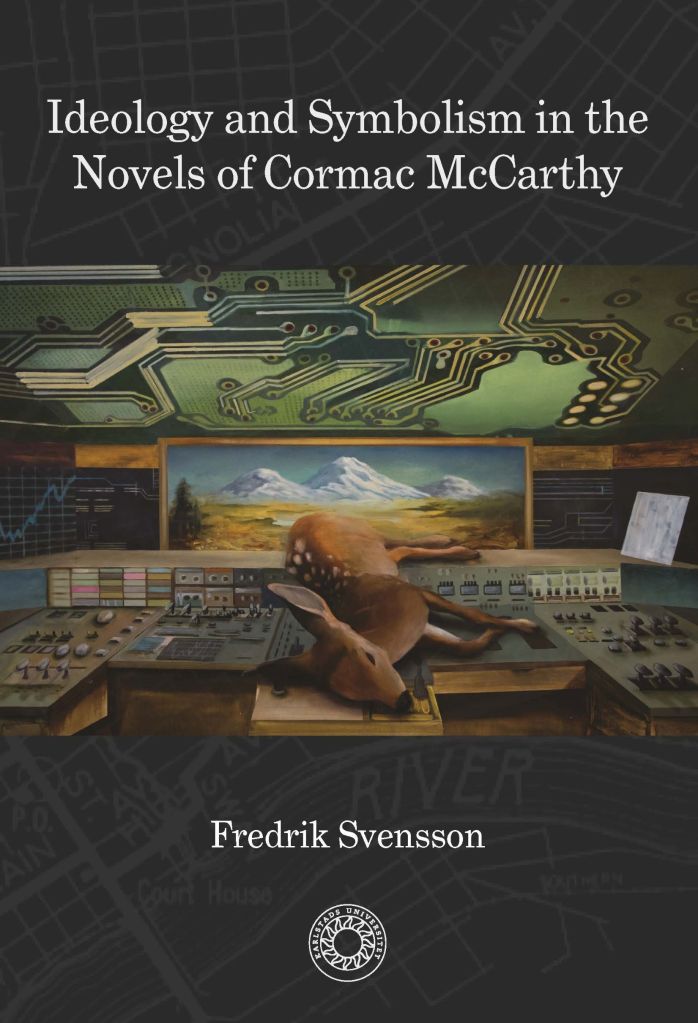
Having said so, what does all of this have to do with the heading of this blog post, Open Learning and Lurking Trolls? Well, all of us who are taking this course in the spring of 2020 are heavily affected in our work by the spread of the Coronavirus. Many of us need to deal with switching from campus to online teaching while, at the same time, we are involved in online learning ourselves. Personally, I had to step in and chair a disputation because other people had fallen ill. I believe it was the first disputation at my faculty that took place via Zoom (and I call it a zoomputation). Everybody involved prepared carefully in advance, checking time zones and the technique the day before with committee members spread around the globe, and so forth. Fredrik Svensson defended his thesis Ideology and Symbolism in the Novels of Cormac McCarthy brilliantly! It was a great defense and a very dynamic discussion between the doctoral candidate and his opponent, professor Nicholas Monk, University of Nebraska-Lincoln. Everything went well, interesting comments and questions from the three members of the examination committee followed. Everything perfect, and at this point, I was a very pleased chair of the zoomputation. Everything perfect, up until the very last moment of the final comment from the third committee member: Suddenly her beautiful face on the large screen in the auditorium was replaced with ugly graphic pictures… At first, I honestly couldn’t believe what I saw, but once my brain had registered what had just happened – an unwelcome TROLL had stepped into our OPEN [because disputations are supposed to be OPEN] zoom room and made its ‘voice’ heard,so to speak – I realized “I have to throw this TROLL out, now!”. My tech support had exactly the same realization and idea. But hey, here comes another TROLL, with another taste for graphic pictures…
At this point, I simply faced the camera and told the opponent and committee members that we would need to change zoom rooms for their up-coming exam discussion and that I would send them a link to the new room via email. I thanked everybody (except the TROLLS) for attending the disputation via zoom (about 33 people) and in the room (adopting social/physical spacing, about 25 people), and then closed the OPEN online and physical session.
Lesson learned: As a teacher, from now on, I will always lock my zoom room. But, what do we do with OPEN zoomputations? We need good, technical solutions! Although we managed to laugh about the incident afterwards, it was unpleasant when it happened.
Some days after Fredrik’s defense, FBI warned against zoombombing (I watched CNN) and then Alastair Creelman posted The week I got Zoombombed. Advantages and disadvantages of open technology? Implication for online teaching and learning? We need a new course module: Online Learning and Lurking Trolls.
Suitable ending quote from “The Battle for Open” (Weller, 2014, p. 22) on what he calls a more complex picture:
“Time to rejoice, one might think, but, of course, as the first lesson shows us, it’s never that simple. When it was simply open vs. closed there was a clear distinction: Openness was good, closed was bad. As the victory bells sound, though, it doesn’t take much examination to reveal that it has become a more complex picture. This is the nature of victory.”

I checked out Beetham and Sharpe’s (2011) theoretical framework, Jisc. I looked for a definition of digital literacy and found this: “Digital literacy looks beyond functional IT skills to describe a richer set of digital behaviours, practices and identities. What it means to be digitally literate changes over time and across contexts, so digital literacies are essentially a set of academic and professional situated practices supported by diverse and changing technologies.” I agree – to be digitally literate definitely changes over time and across contexts. They (or at least I think it was these two scholars?) talk about the seven elements of digital literacies (i.e., media literacy, communications and collaborations, career and identity development, ICT literacy, learning skills, digital scholarship, and information literacy) and for me (both as a teacher and as a user of ICT), ICT literacy and learning skills would be the most important (or relevant) literacies. I need the functional skills that Beetham and Sharpe introduce in their framework! Further, I enjoyed the online hour with David White. It went by fast! Right now I am wondering about how to define digital literacy in my own academic context; for example, what is digital literacy in second/foreign language (L2) English and for teachers of L2 English? What does it entail? This week I also came across a paper by Bennett (2014), who discusses Jisc, and she explores the developing practices that surround the adoption of Web 2.0 and how lecturers make use of digital tools. She touches upon students’ needs (and needs analysis is something we will include in our group’s presentation, so that made me happy) as well. Quite an enjoyable read.
I enjoyed our meetings online with PBL13. Sebastian and I have cooperated running ‘Topic 1’ and I hope it turned out OK for everybody.
After a depressing week with the Coronavirus spreading across the globe, causing so much pain and sorrow, and at the same time a week during which I have kept up with my regular work duties plus participating in this course (and never found the time to buy myself a decent headset, arghhh!), I feel almost as if I have had a Digital Participation OverDose (a.k.a., DPOD). I will log out Friday night and log on again Saturday after a long, slow run in the woods.
Refs
Beetham, H., & Sharpe, R. (2011). Digital literacies workshop. Paper presented at the JISC Learning Literacies Workshop, Birmingham. http://jiscdesignstudio pbworks.com/w/page/40474566/JISC
Bennett, L. (2014). Learning from the early adopters: developing the digital practitioner. Research in Learning Technology, 22. Retrieved from https://journal.alt.ac.uk/index.php/rlt/article/view/1450/pdf_1

This is a short reflection on our Connecting week in the ONL201 course. I only learned that I would take the course a few days before it actually started, and I am happy to be on board, so to speak. We have had the starting week and then a Connecting week. For me, the first online meeting was a rather neat experience. It was fun to see so many people from different countries and from different academic disciplines. I learned that I will work with colleagues in PBL group 13. We decided to keep the group name with the unlucky number, which I think was a cool decision to make. What else? I managed to create a blog account and I have posted by first blog post. Quite an achievement.
This is just my test.

This is an example post, originally published as part of Blogging University. Enroll in one of our ten programs, and start your blog right.
You’re going to publish a post today. Don’t worry about how your blog looks. Don’t worry if you haven’t given it a name yet, or you’re feeling overwhelmed. Just click the “New Post” button, and tell us why you’re here.
Why do this?
The post can be short or long, a personal intro to your life or a bloggy mission statement, a manifesto for the future or a simple outline of your the types of things you hope to publish.
To help you get started, here are a few questions:
You’re not locked into any of this; one of the wonderful things about blogs is how they constantly evolve as we learn, grow, and interact with one another — but it’s good to know where and why you started, and articulating your goals may just give you a few other post ideas.
Can’t think how to get started? Just write the first thing that pops into your head. Anne Lamott, author of a book on writing we love, says that you need to give yourself permission to write a “crappy first draft”. Anne makes a great point — just start writing, and worry about editing it later.
When you’re ready to publish, give your post three to five tags that describe your blog’s focus — writing, photography, fiction, parenting, food, cars, movies, sports, whatever. These tags will help others who care about your topics find you in the Reader. Make sure one of the tags is “zerotohero,” so other new bloggers can find you, too.
Well done! You imported a post and all categories of the Open Networked Learning course homepage. You can edit or delete this post, then start blogging by creating a new post!
You might also want to consider to connect your blog to the ONL course homepage.

 Pia Sundqvist's Blog